EDGE Research Report
Market Review
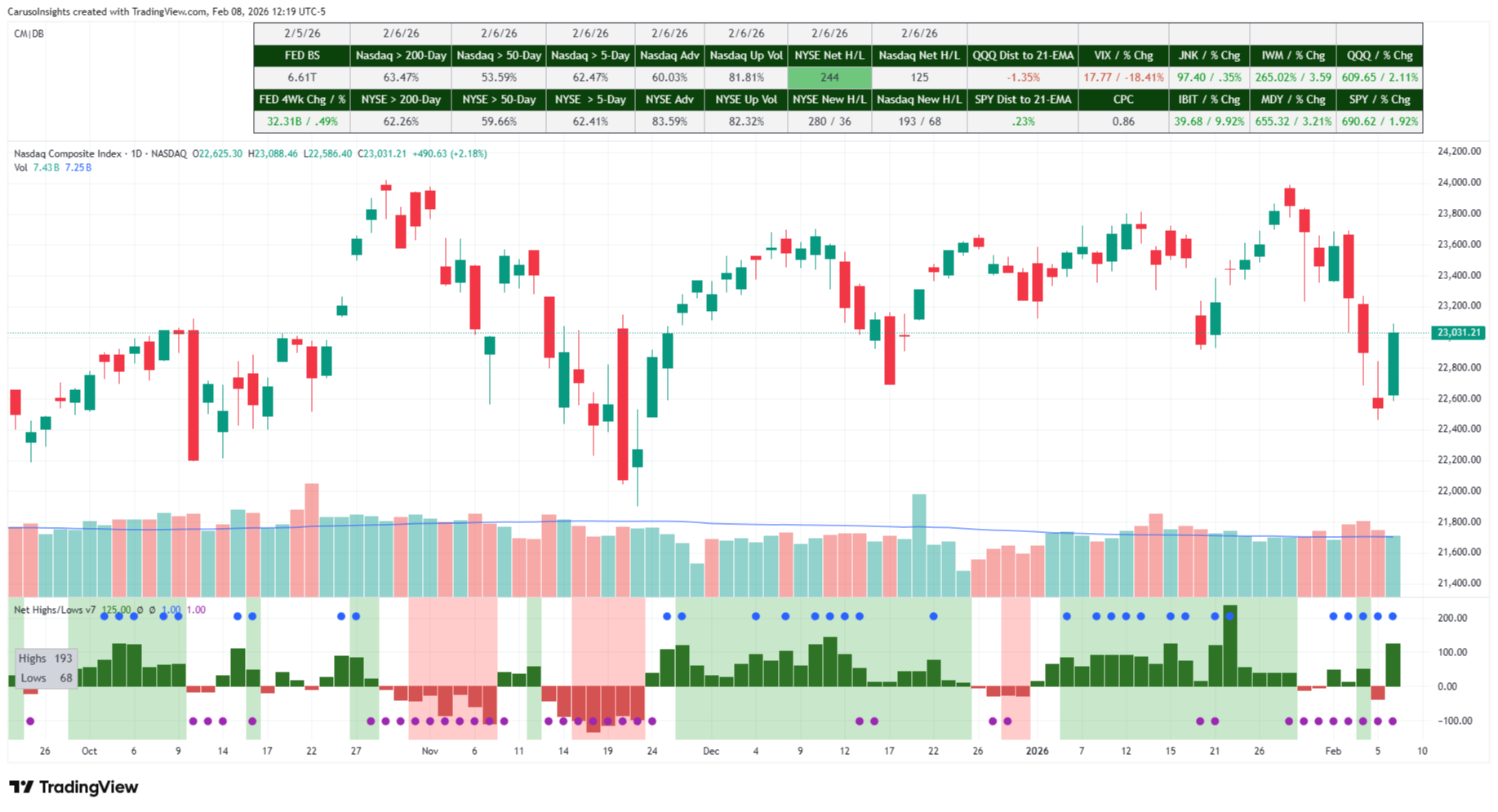
Perhaps the best summary of this past week is the fact that despite the Nasdaq 100 gaining 2.1% on Friday, it still ended the week down roughly 2%. The S&P 500 also finished the week slightly lower but remains in roughly the same area it has traded since late December.
Despite the amount of attention given to technology and AI, the biggest weekly gainers were Consumer Staples (XLP +5.3%) and the Dow Jones Industrial Average (+2.45%), while one of the weakest areas was Software (IGV -8.7%).
This dynamic of “old world” stocks leading while software sells off has created an incredible amount of volatility and abnormal readings across many market indicators. There have been plenty of winners and losers, but the elevated volatility has made this a very difficult environment for trend followers, particularly those focused on growth stocks.
It is in environments such as these that we need our guiding light — which, as William O’Neil put it, is a focus on stocks that change how we live, work, or play. With such large gains already behind them and so much attention on growth stocks, the group has faced a difficult environment since late 2025. However, unless toothpaste and Pepsi are about to become the world’s next growth engines, this current market dynamic is unlikely to persist.
We may be seeing an important turning point in this technology revolution. In 1995, we had the “Netscape moment,” when the first widely used web browser transformed the internet from an academic tool into something mainstream. That shift marked the beginning of tech leadership moving beyond infrastructure stocks (such as CSCO for routers or EMC for databases) and into consumer-facing products. The rise of Yahoo, Schwab, AOL, and many others followed.
How does that relate to today? Software stocks are breaking down as AI — particularly agent-based systems such as Anthropic’s CoWork — rewrites what it means to “have software.” The tremendous moats these firms once enjoyed appear to be eroding simultaneously. The result has been steep declines in former tech leaders and cascading volatility across the broader group, including names not directly impacted by these changes.
Rather than becoming overwhelmed by the volatility, our focus is to keep an eye on the bigger picture while staying fixated on stocks with tremendous upside, all while seeking entry points with effective risk management.
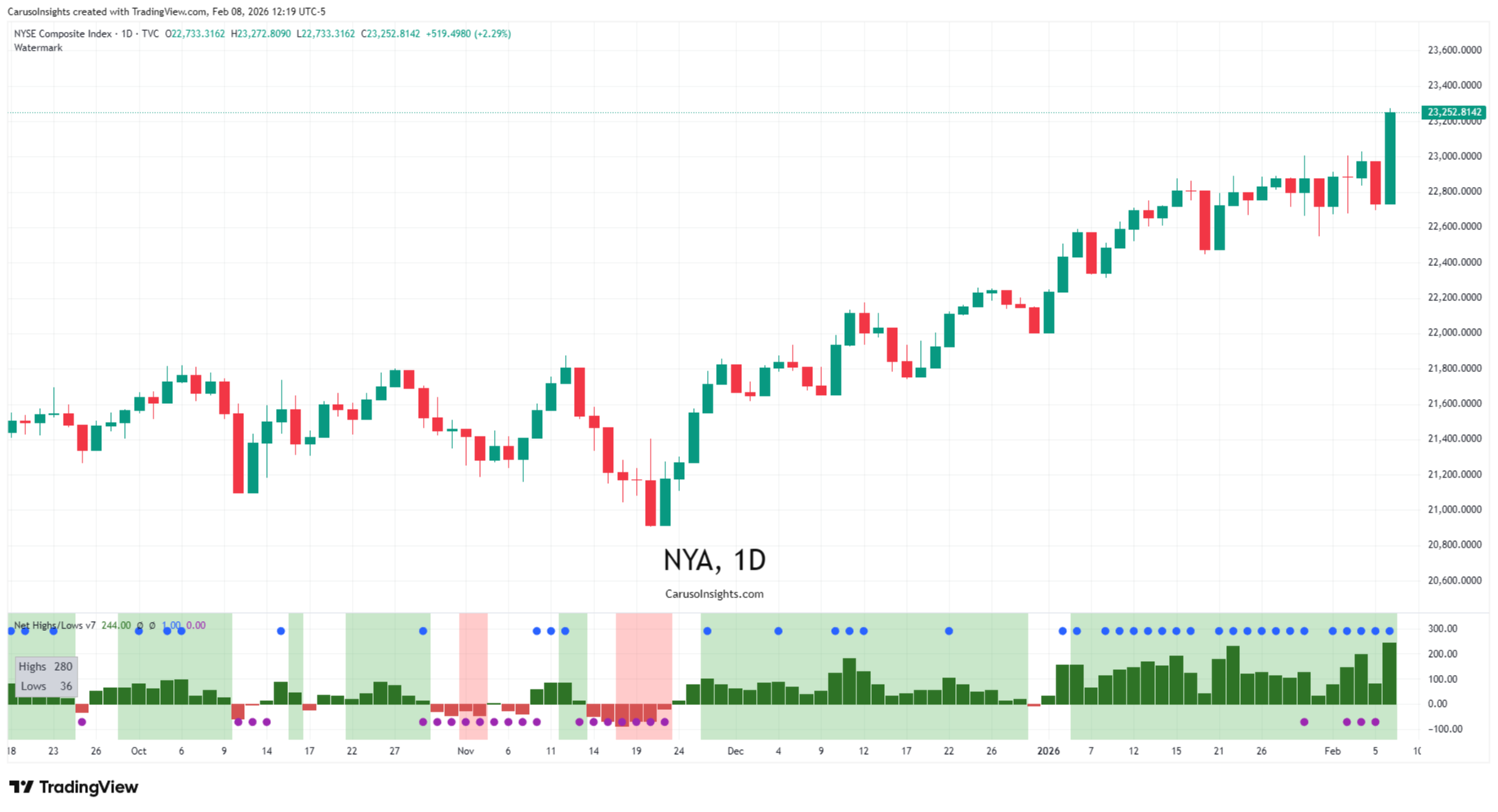
Despite the volatility, Friday saw more stocks making 52-week highs than 52-week lows on both the NYSE and Nasdaq composites, indicating that capital is still flowing into the market. Once investor concern shifts away from AI’s current “destructive” phase, we will likely see money rotate out of Staples and back into growth. Relative strength analysis will remain our guide as we navigate a tremendously fast-moving market beneath seemingly quiet indexes.
Macro data to watch this week includes the delayed Jobs report on Wednesday pre-market, followed by CPI on Friday morning.
Tactical Thoughts & Setups
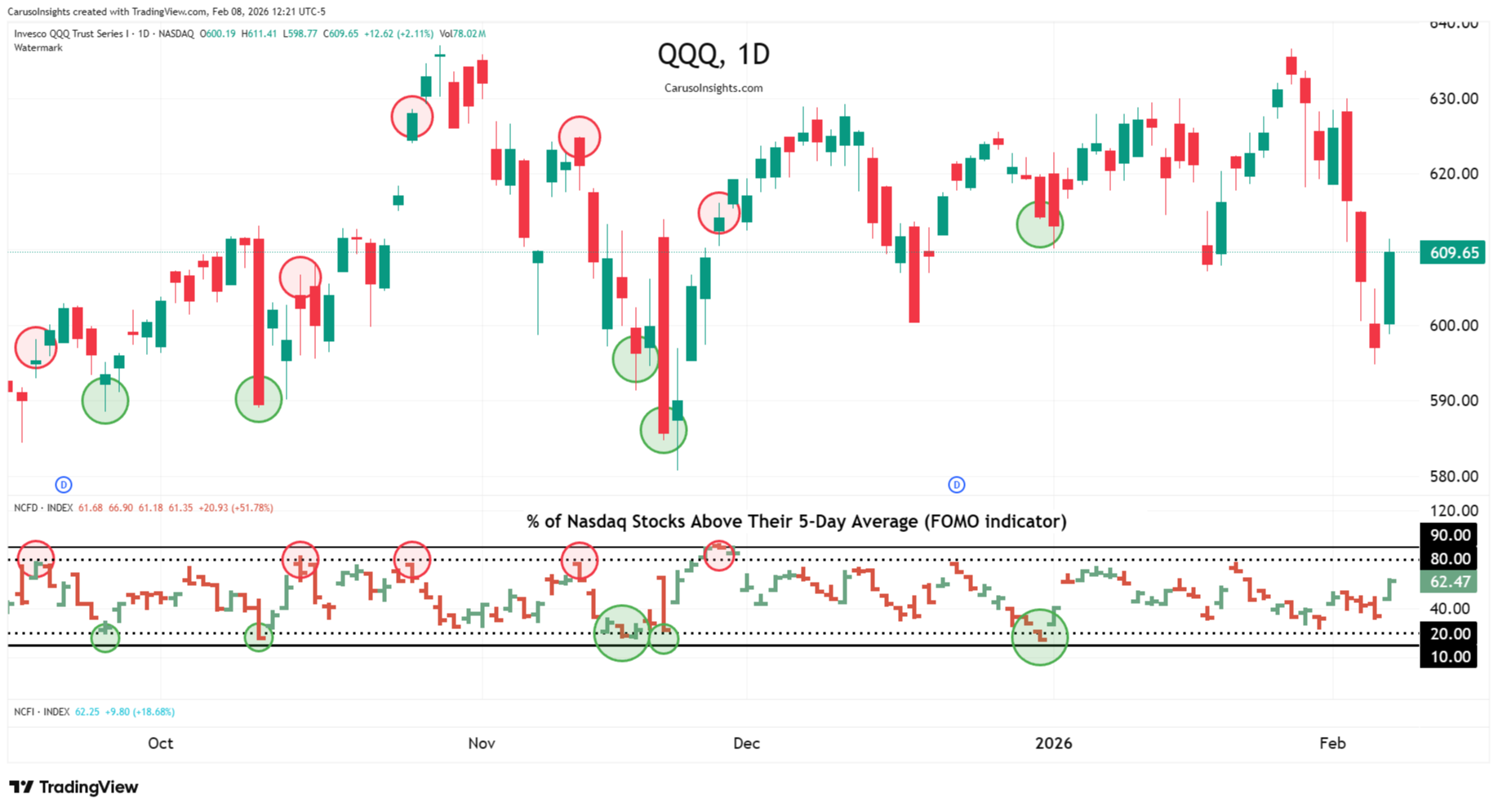
Our FOMO indicator has remained neutral throughout 2026, as this year has been defined by rotation rather than widespread fear or euphoria. For trend followers, the lack of a unified market direction has meant that traditional breakouts or buying into strength have had a high failure rate — particularly given the elevated volatility in growth stocks.
In choppy markets, investors must place even greater emphasis on relative strength, as it is often the clearest way to identify where institutions are actively buying or selling. That said, the volatility of this environment can make leadership feel as though it is constantly shifting.
For this reason, it is helpful not only to study strong individual stocks, but also to group them into themes, as institutions tend to position portfolios with that framework in mind.
The past week produced extremely wide trading ranges across most stocks, making even the strongest names difficult to position. A stock’s trading range is often the “cost of doing business,” and many leading growth stocks experienced daily swings of 7% or more. This forces us to consider not just the company, chart, and relative strength, but also the recent volatility of the stock itself.
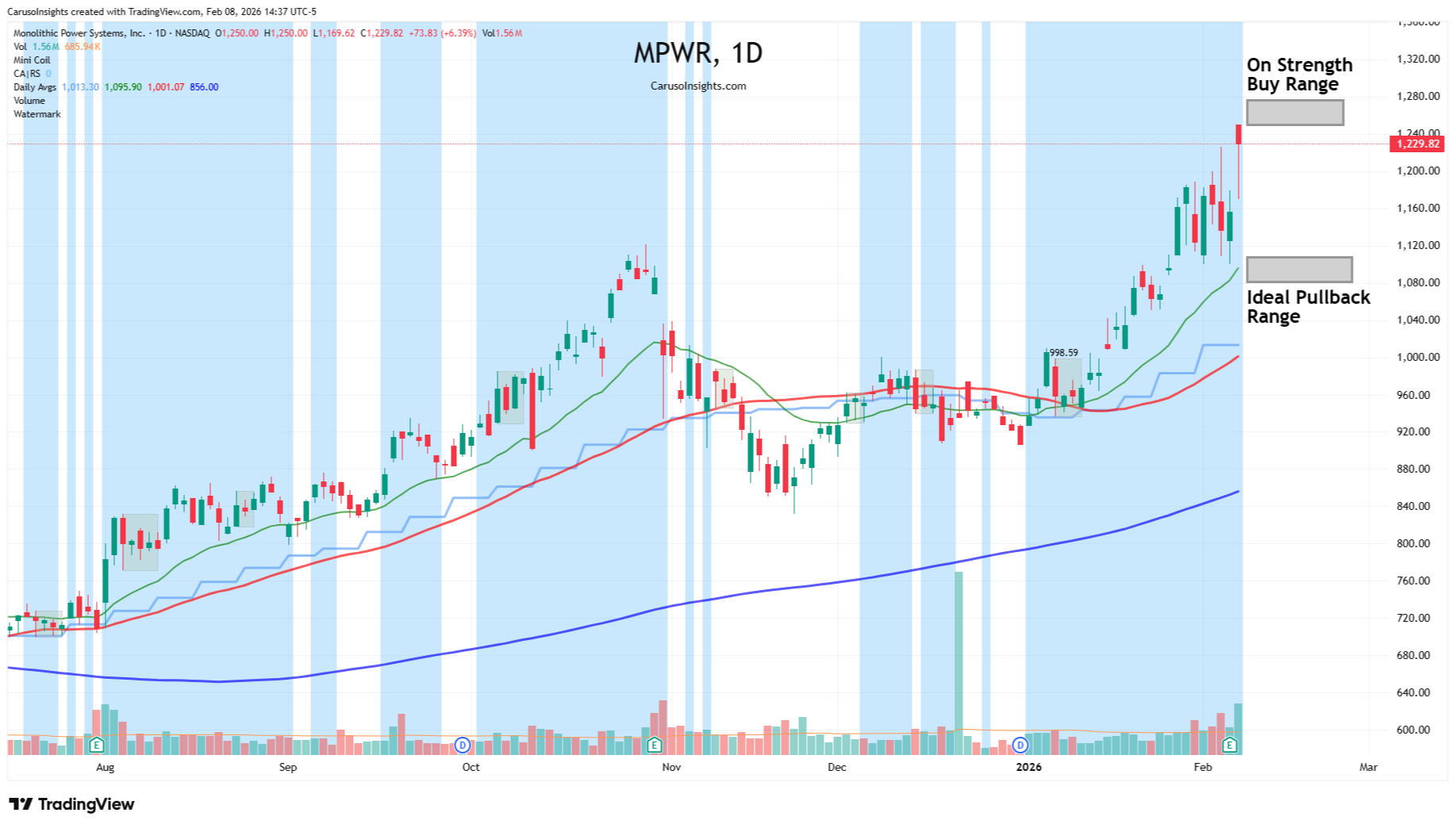
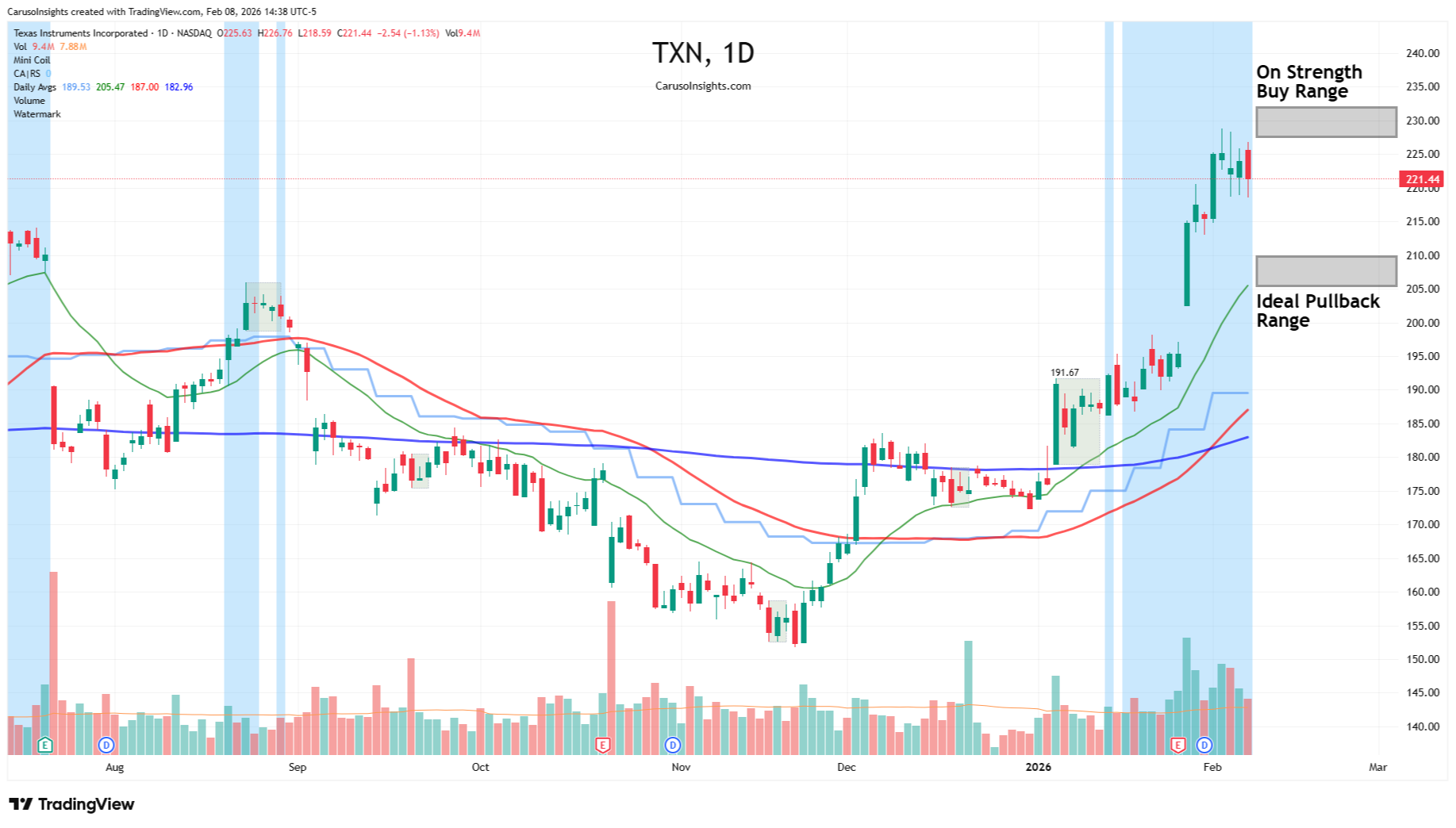
Today’s top stocks include TXN and MPWR from the Analog and Power semiconductor group. While NVDA and AVGO have lagged, “real-world” semiconductors have taken the lead as massive CAPEX spending fuels a re-industrialization trend. Both TXN and MPWR are emerging from well-structured bases alongside a re-acceleration in fundamentals. They are set up to be bought into strength if momentum continues, and also offer pullback opportunities should market weakness return and they retrace toward their 21-day averages.
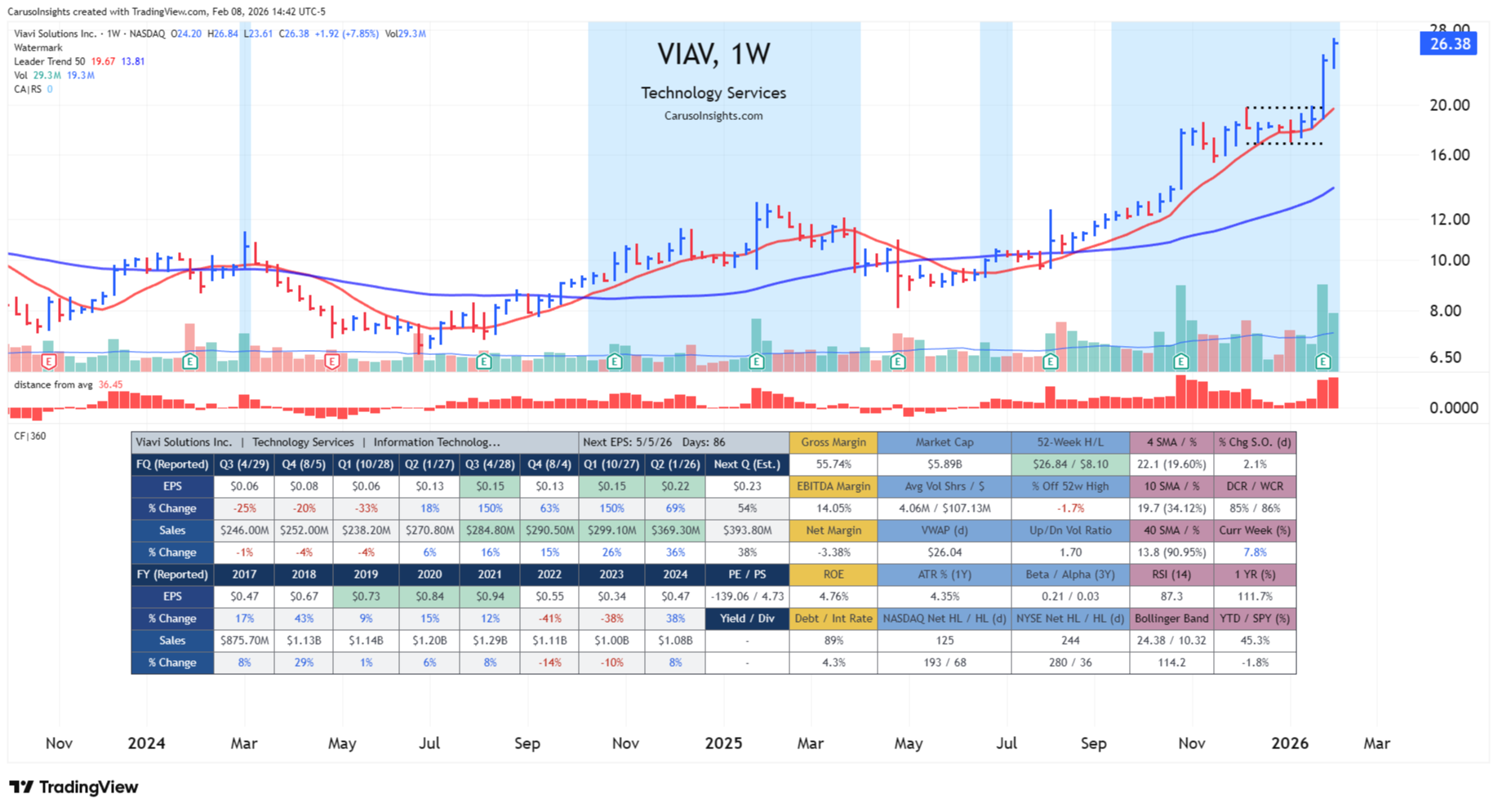
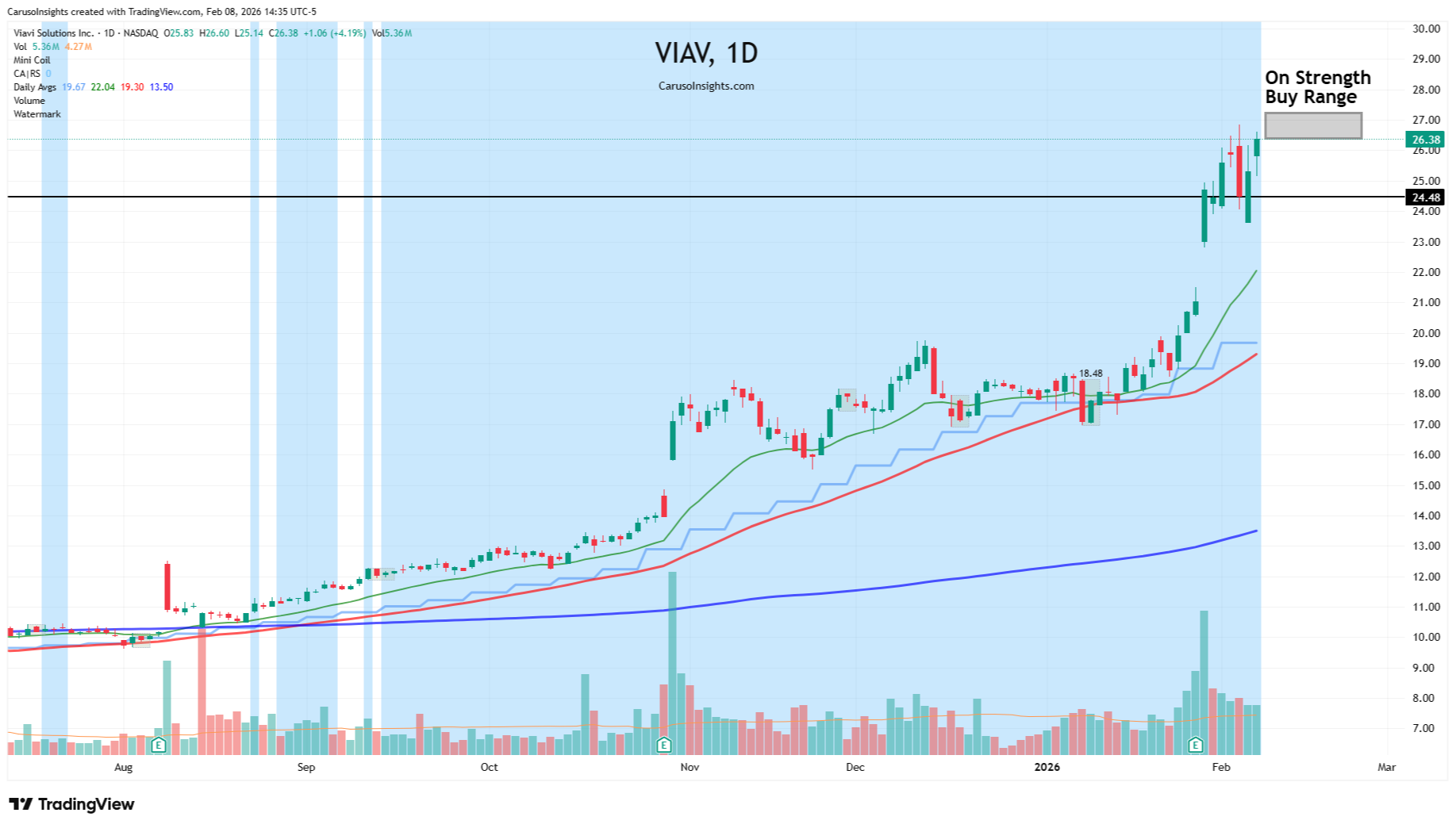
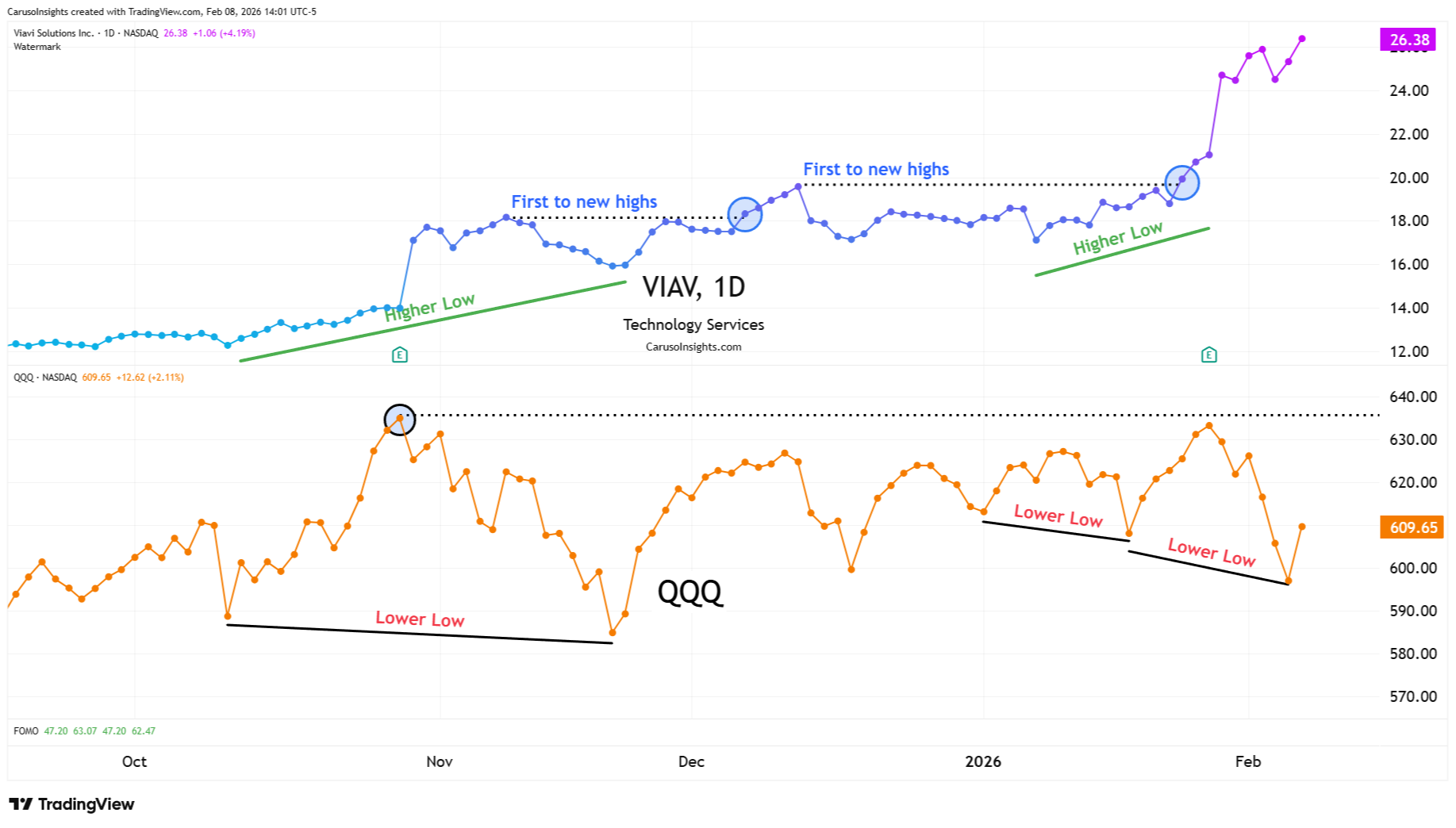
Another strong tech-adjacent group has been optics, as data centers are paying up to move data faster via optical components rather than copper. VIAV, which provides testing equipment for optical gear, has delivered two strong quarters in a row. While extended, it has shown notable resilience during the Nasdaq pullback and remains a top stock to buy into strength should upside momentum continue.
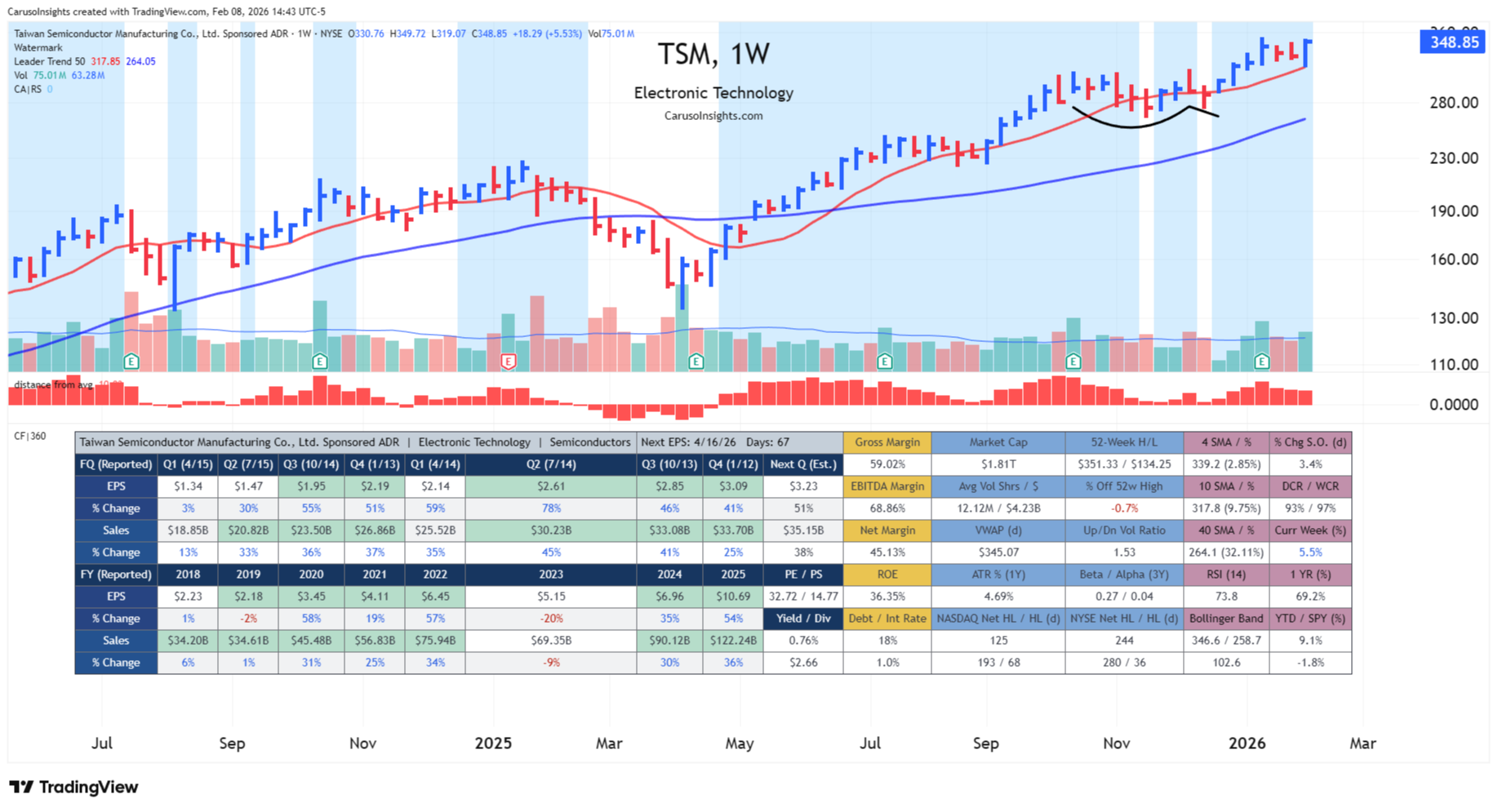
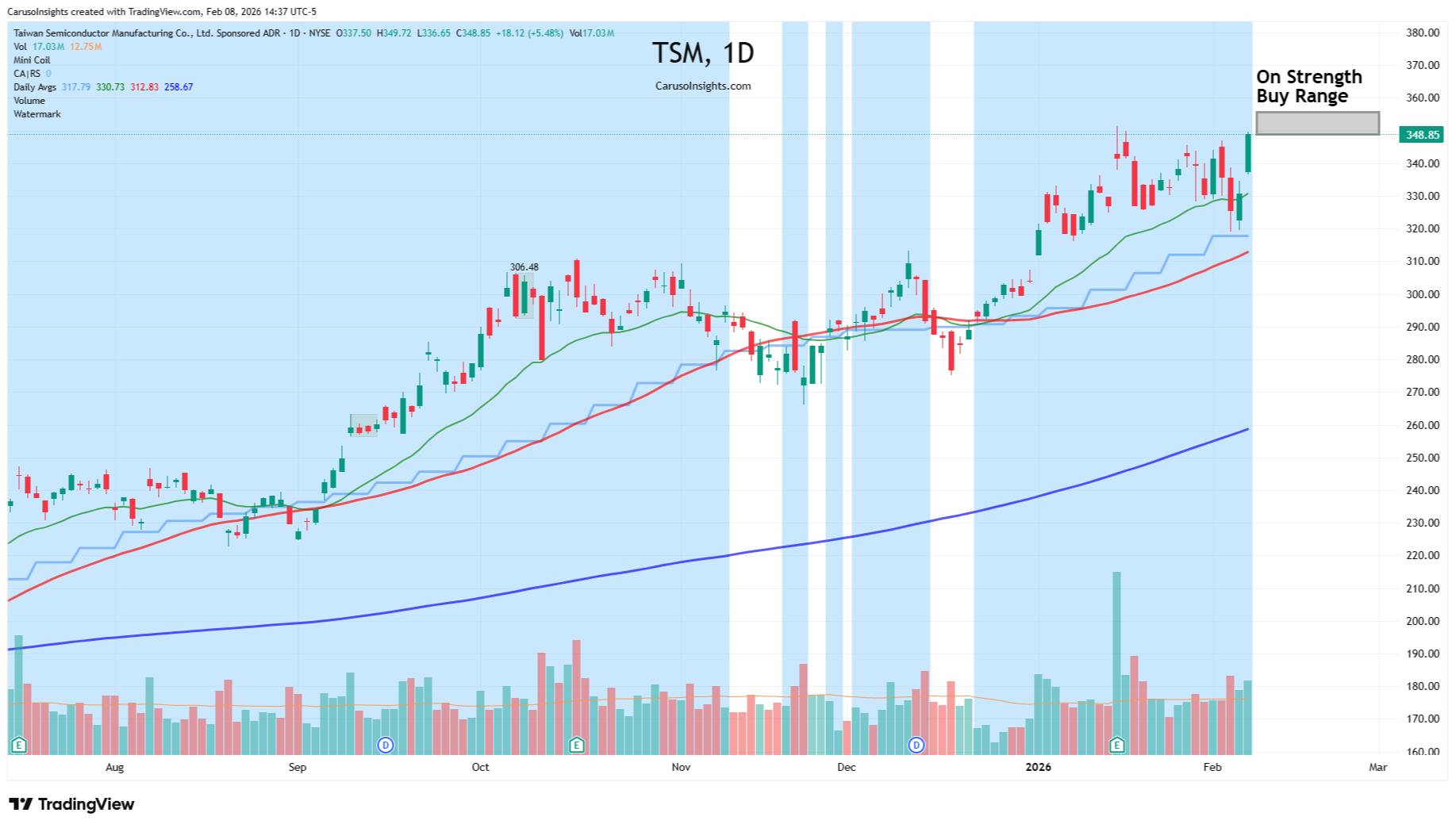
Similar to TXN and MPWR, TSM has significantly outperformed more widely followed peers such as NVDA and AVGO. After a two-day rally approaching 10%, TSM is short-term extended, but would be an ideal candidate if it consolidates constructively after the breakout rather than failing outright.
AI and technology spending continue to drive insatiable demand for power and energy. Solar remains a very eclectic group, with some companies performing extremely well while others struggle. NXT stands out after reacting favorably to earnings and resisting selling pressure during last week’s QQQ decline. Should strength persist, it remains a strong candidate to watch into strength.
Aerospace and defense are also undergoing a major rethink in the AI era, as warfare evolves through drones, hypersonic systems, and space-based capabilities. This shift is occurring alongside President Trump’s push to significantly increase defense spending. For diversified exposure, XAR offers an equal-weighted ETF focused on younger, more dynamic companies within the sector.
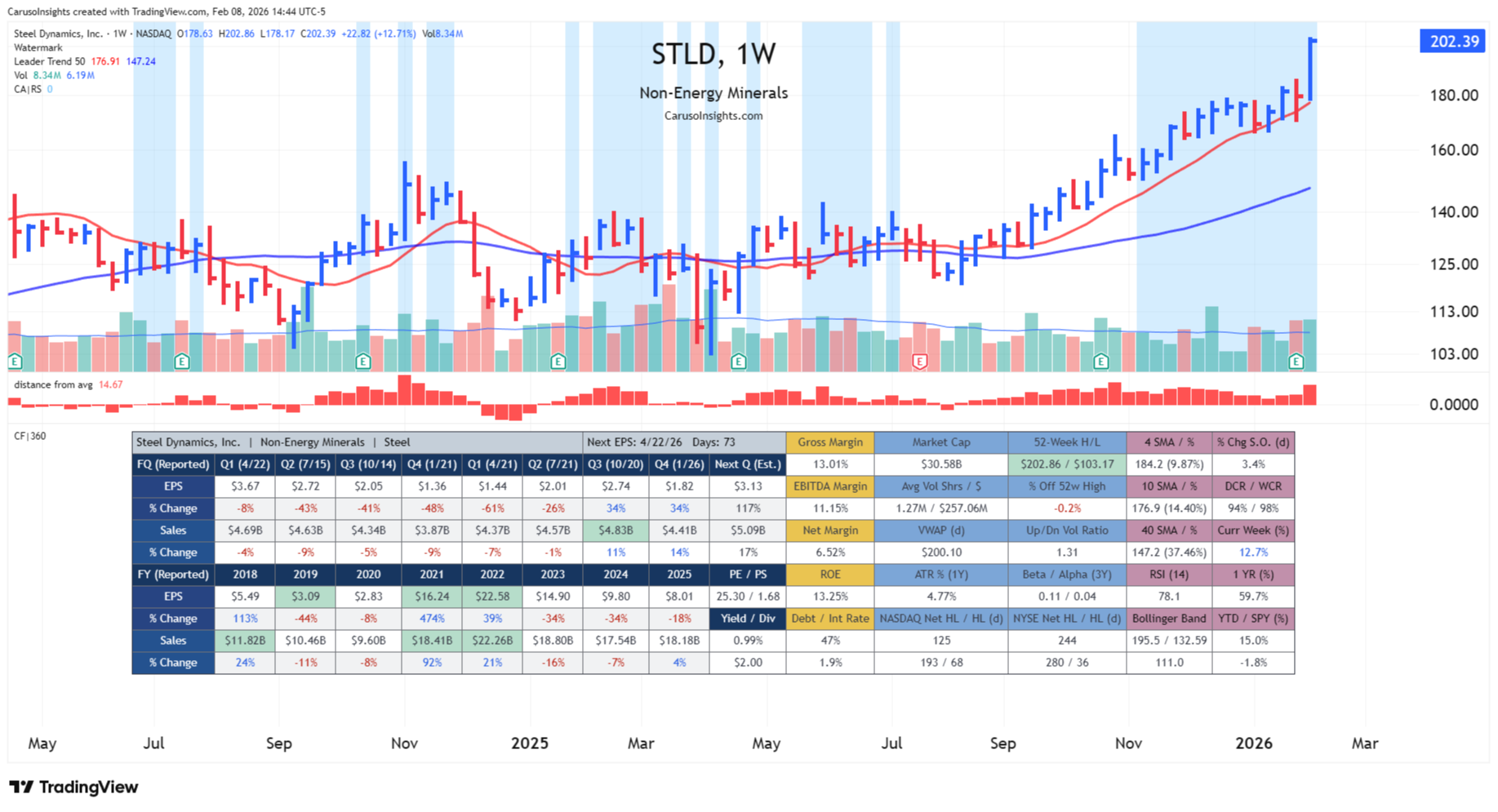
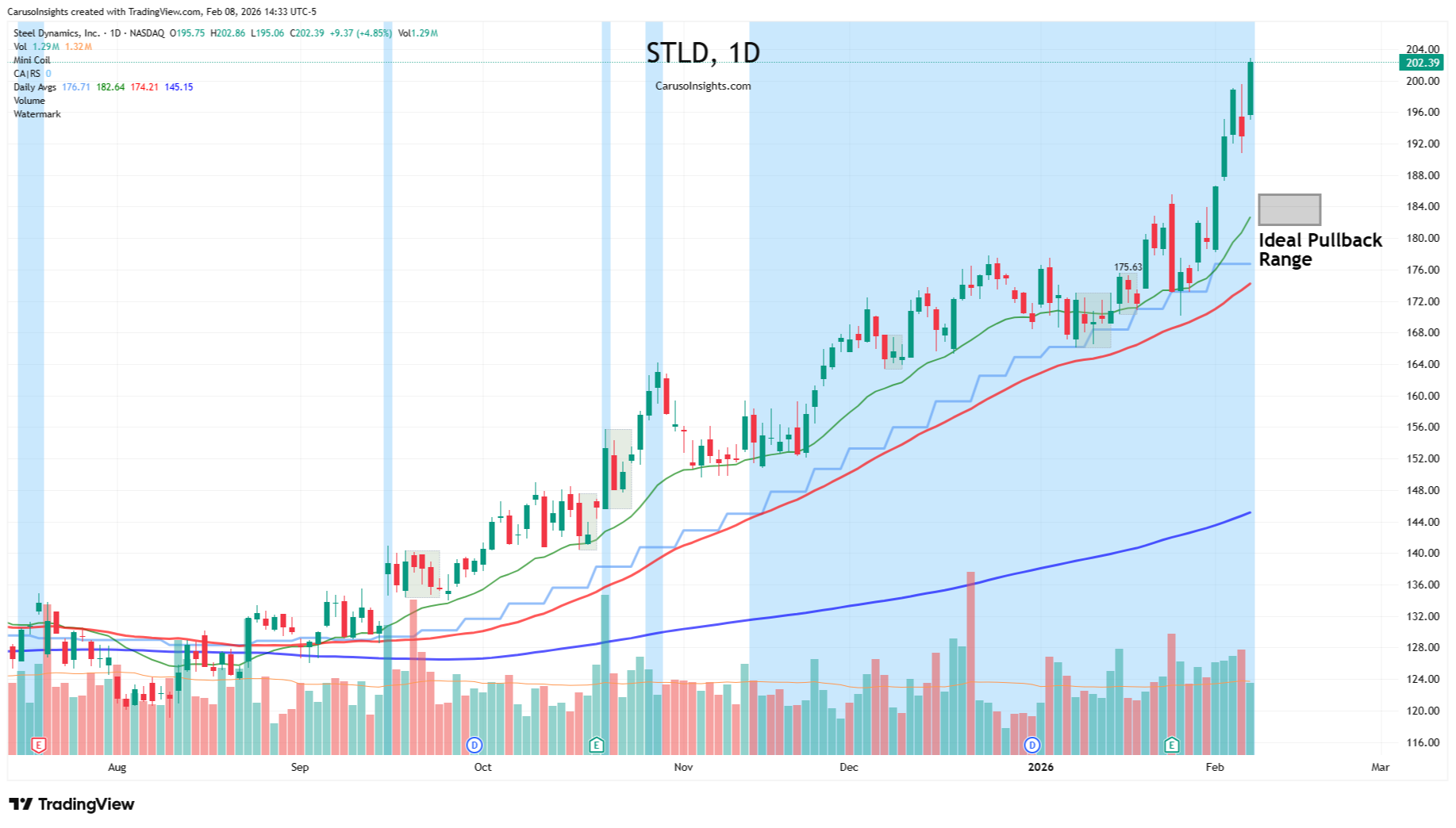
Lastly, STLD continues to benefit from strong steel demand tied to aerospace, AI infrastructure, and electrification trends. After breaking out from a multi-week consolidation, it represents a pullback-buy setup should shares ease.
Concentrate on what will produce results rather than on the results, the process rather than the prize.
Top Stocks To Watch - Relative Strength & Setups
MPWR
Theme: AI Power Infrastructure, Data Center Electrification, High-Performance Power Management
Monolithic Power Systems is a pure-play beneficiary of the “AI = power” reality. As GPUs and custom accelerators scale, the bottleneck shifts from compute to delivering clean, efficient power—and MPWR sits right in the power-conversion stack (voltage regulation, power modules, high-efficiency DC/DC solutions) that data centers, AI servers, and networking gear require.
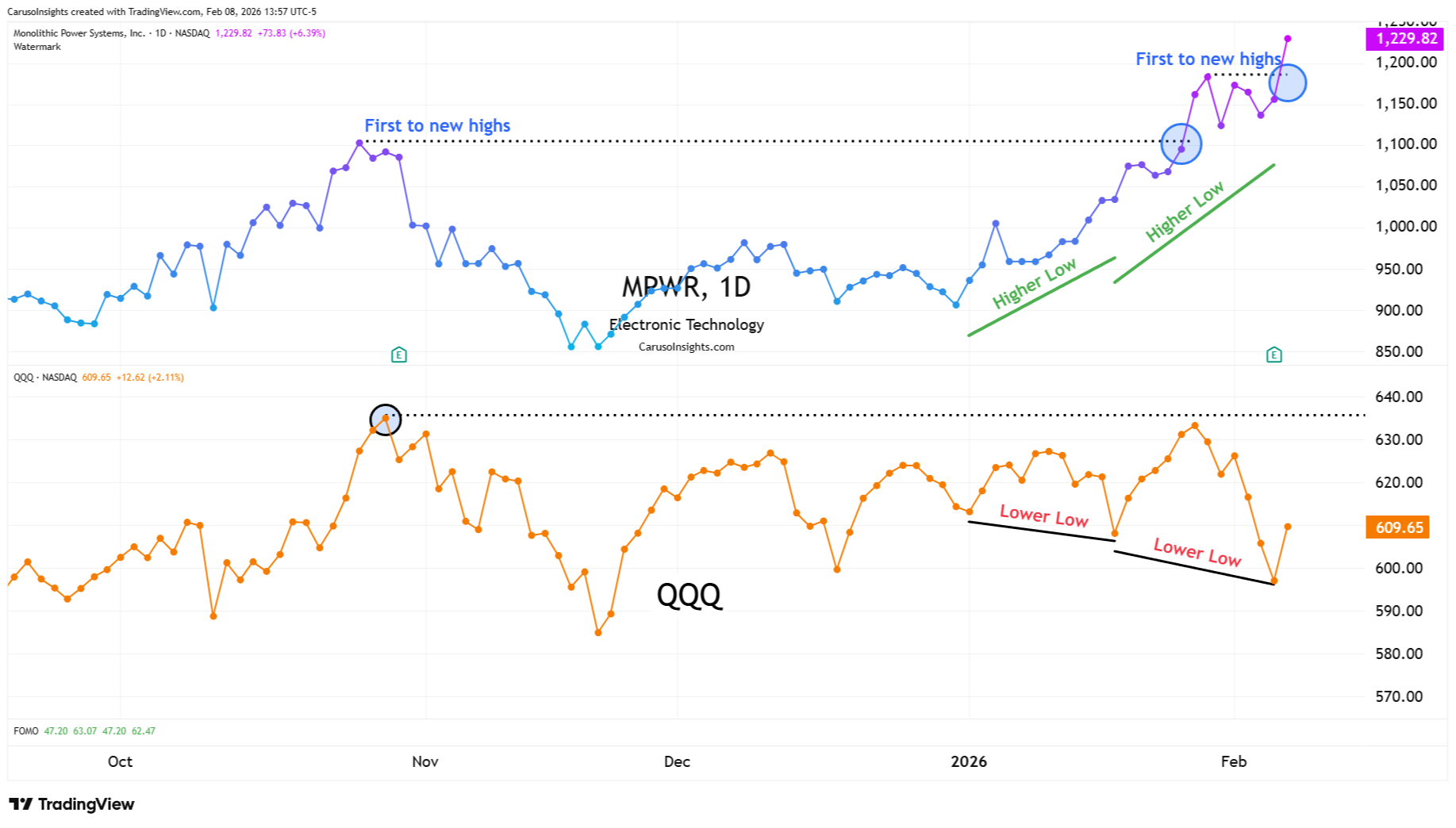
MPWR’s strength is that it’s not dependent on one end-market: the same high-performance power management playbook extends across cloud infrastructure, automotive electrification, and industrial systems. Rising RS indicates institutions want exposure to the AI supply chain without taking direct GPU cycle risk. If the next leg of AI capex is about power density, thermal constraints, and efficiency, MPWR is one of the cleanest “picks-and-shovels” ways to express that theme.
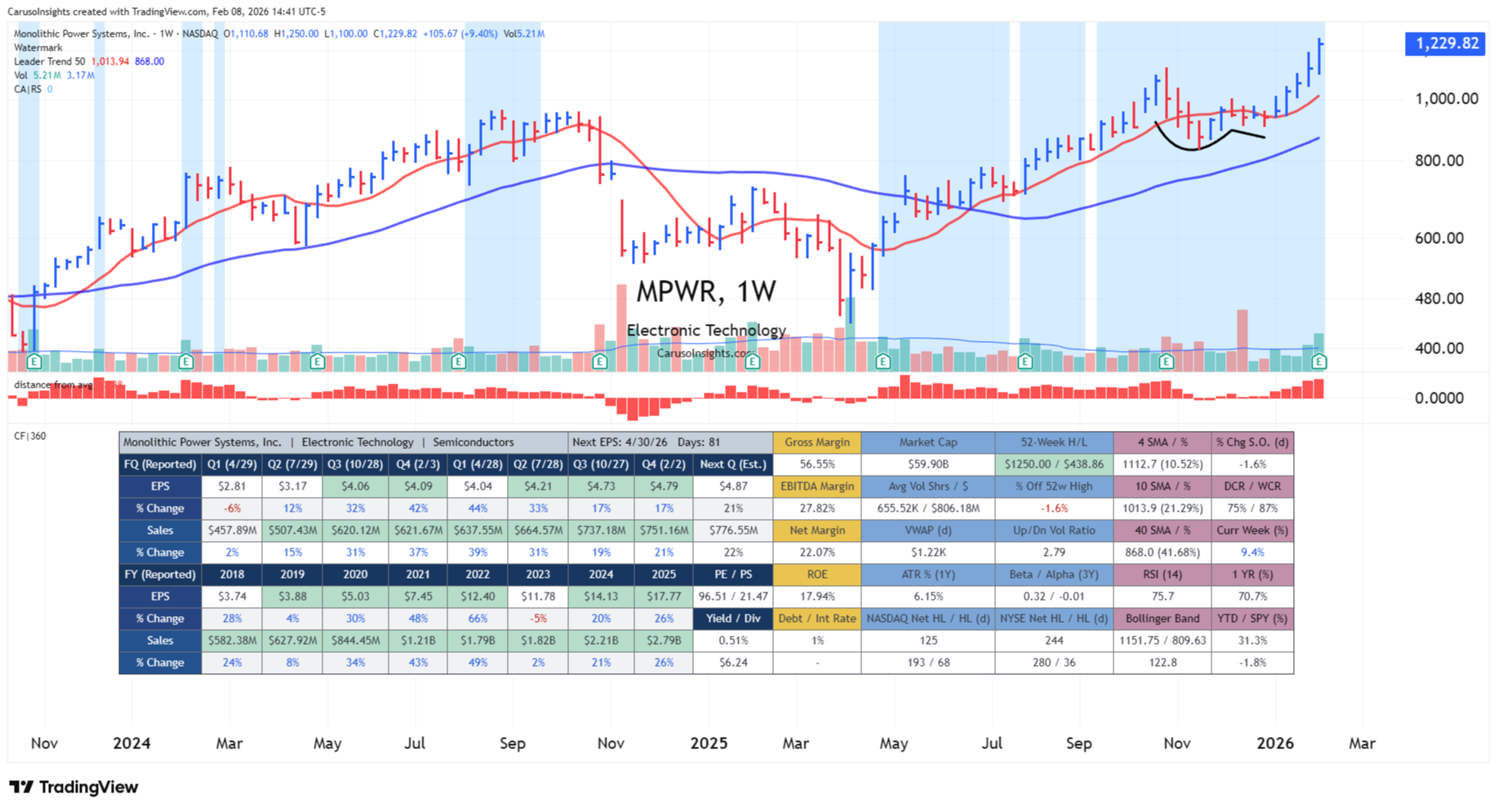
Having gapped up on earnings Friday, It can be considered as a buy into strength should market momentum continue. However, having just broken out of a basing structure, a pullback to the 21ema would also set up a classic failed breakout pullback for buys into weakness.
TXN
Theme: Real-World Semiconductors, Industrial Automation & Robotics, AI Infrastructure Enablement
Texas Instruments is leveraged to the physical side of the AI and automation buildout. Rather than chasing bleeding-edge AI compute, TXN supplies the analog and embedded chips that make real-world systems function—power management, sensing, motor control, and connectivity across factories, robotics, autos, and industrial equipment.
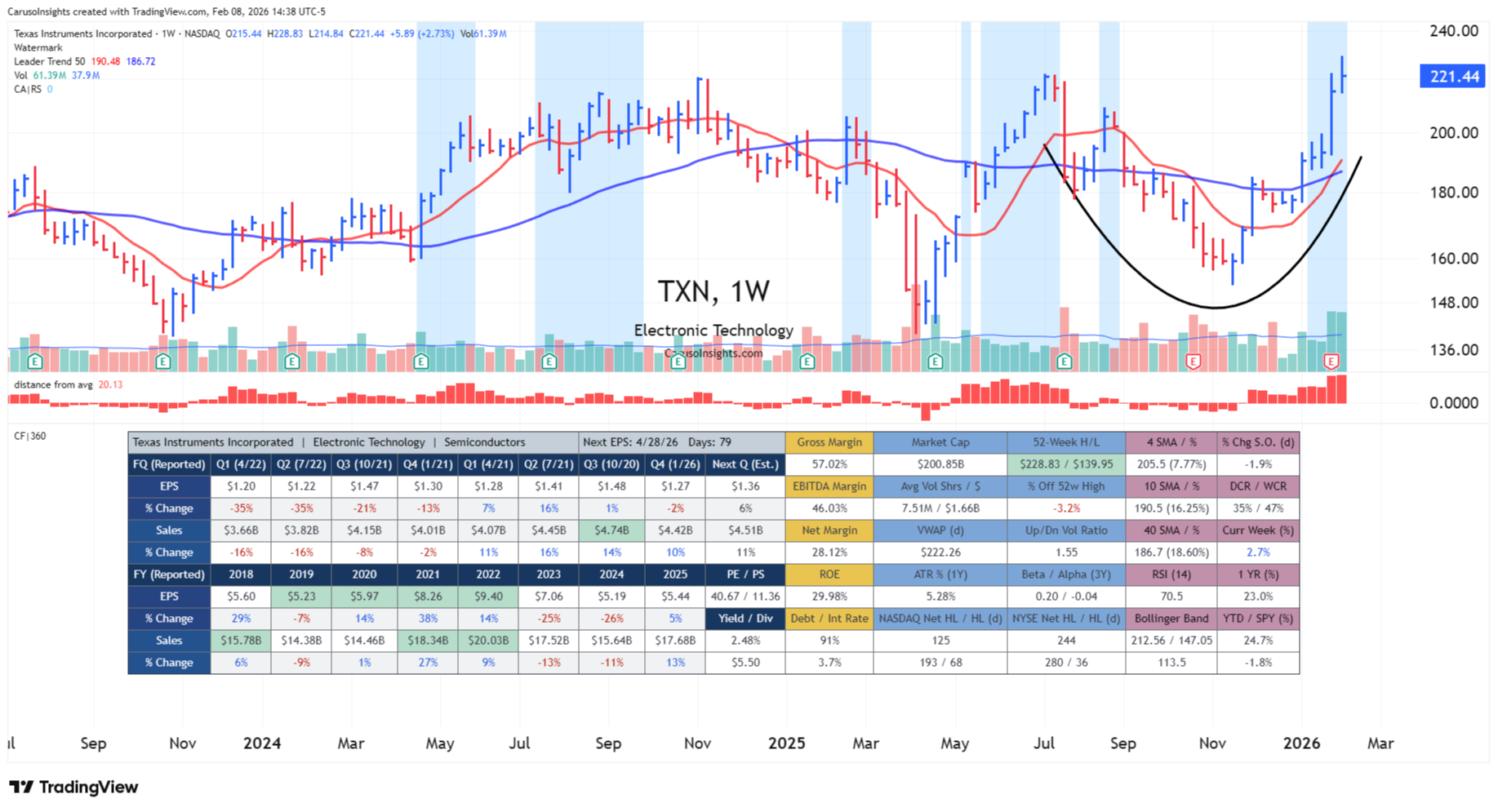
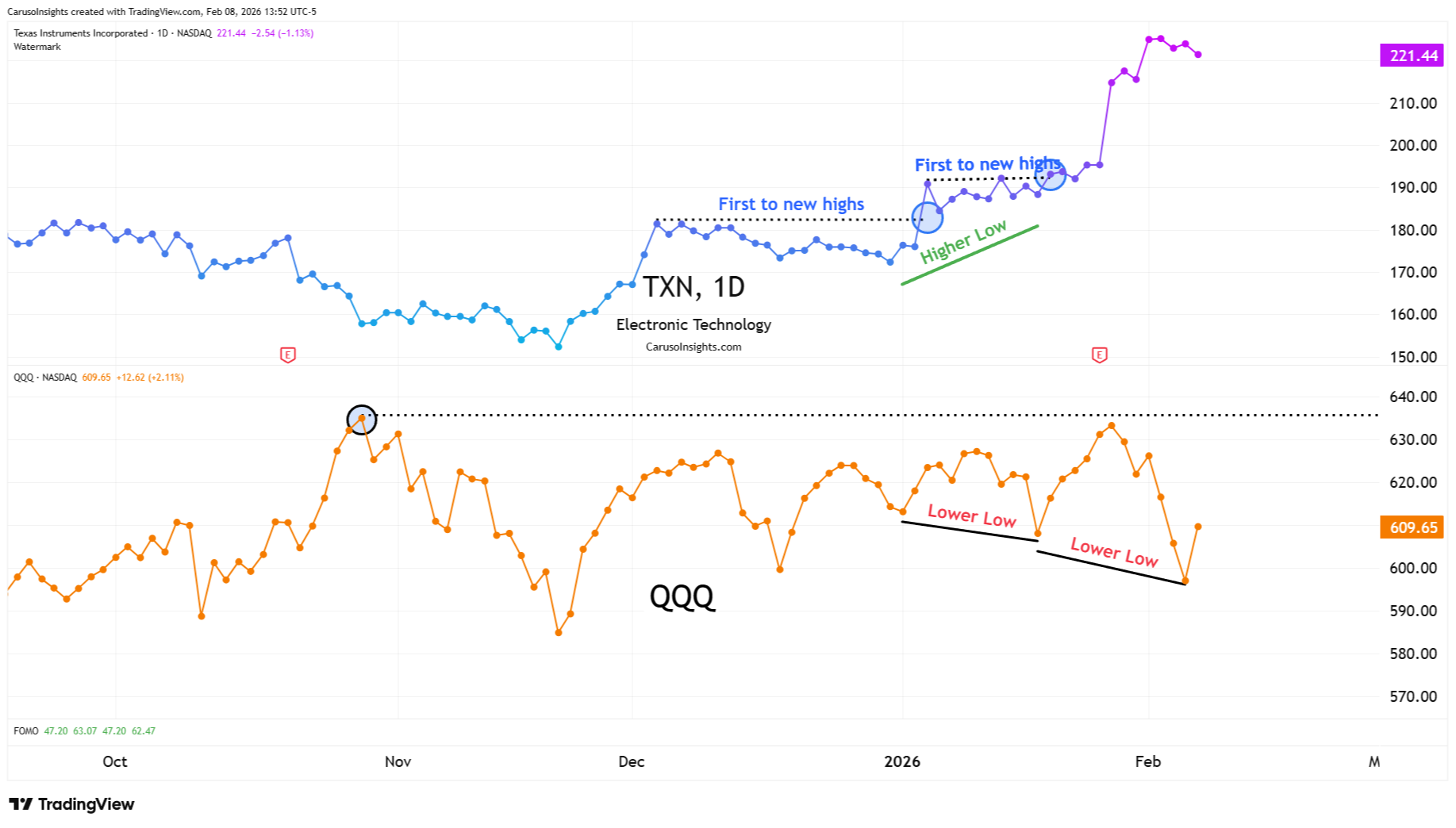
As can be seen in the RS Chart, TXN has been leading the Nasdaq higher since it broke to new highs first at the start of the year. Having formed a Cup base, it has moved into new high ground as its fundamentals begin to turn around along with other group members such as MPWR, and ADI.
As it pauses at the high of its cup, it is reasonable to expect a pullback to its 21ema which would be a Failed Breakout Pullback setup. Likewise, should market momentum continue, it has formed a mini coil and can be considered as a buy with upside momentum.
NXT
Theme: AI-Driven Energy Infrastructure, Utility-Scale Solar, Grid Modernization
Nextracker sits at the intersection of AI, power demand, and real-world infrastructure. As data centers, electrification, and AI workloads drive massive incremental electricity needs, utilities are accelerating investment in large-scale solar and grid resiliency. NXT’s tracking systems improve energy yield and efficiency, making solar projects more economically viable at scale.
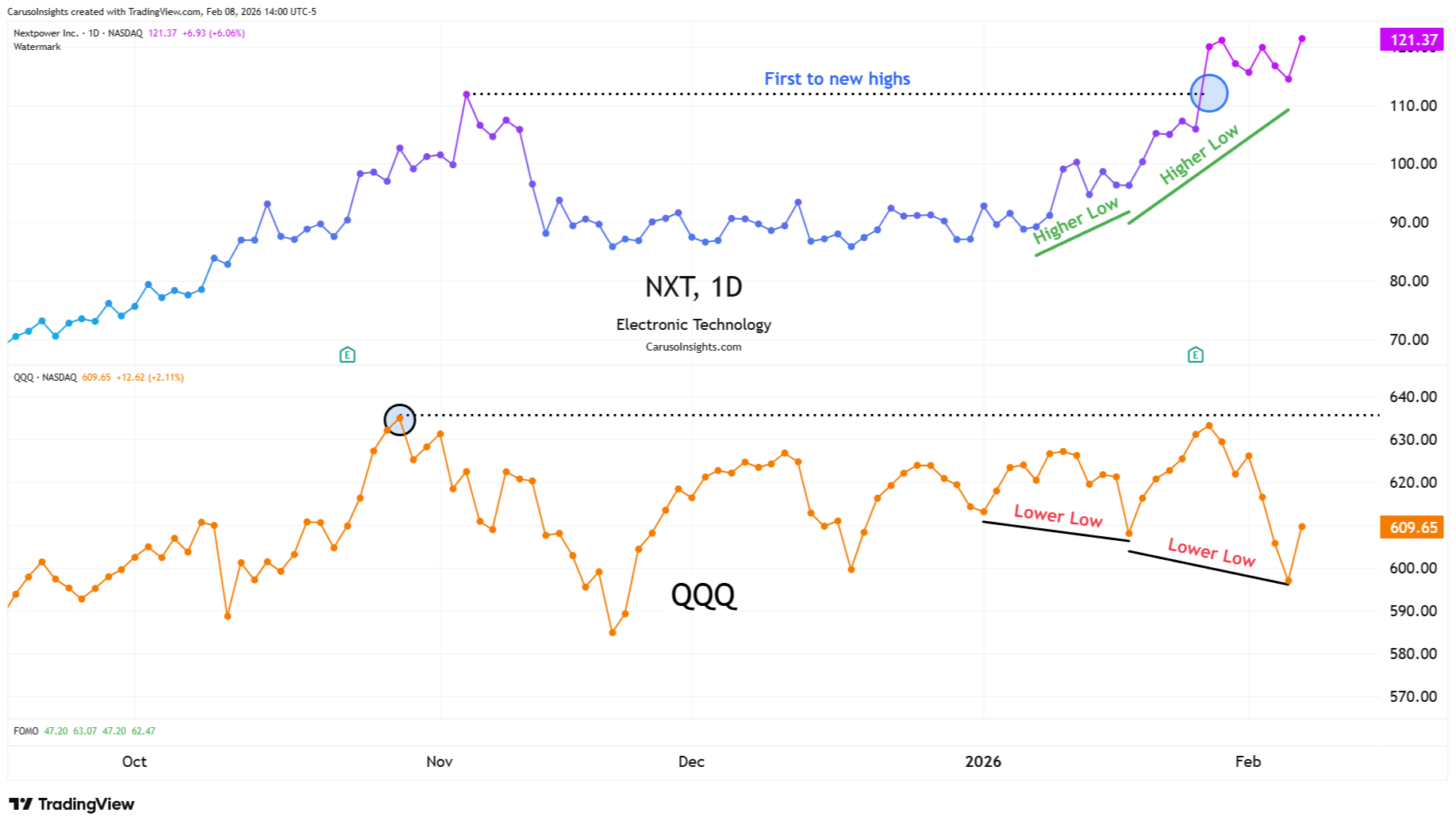
With energy now a binding constraint for AI expansion, capital is rotating toward companies enabling power generation and grid build-out. NXT’s strong relative strength reflects institutional recognition that the AI cycle extends well beyond chips—into the physical infrastructure required to power it.
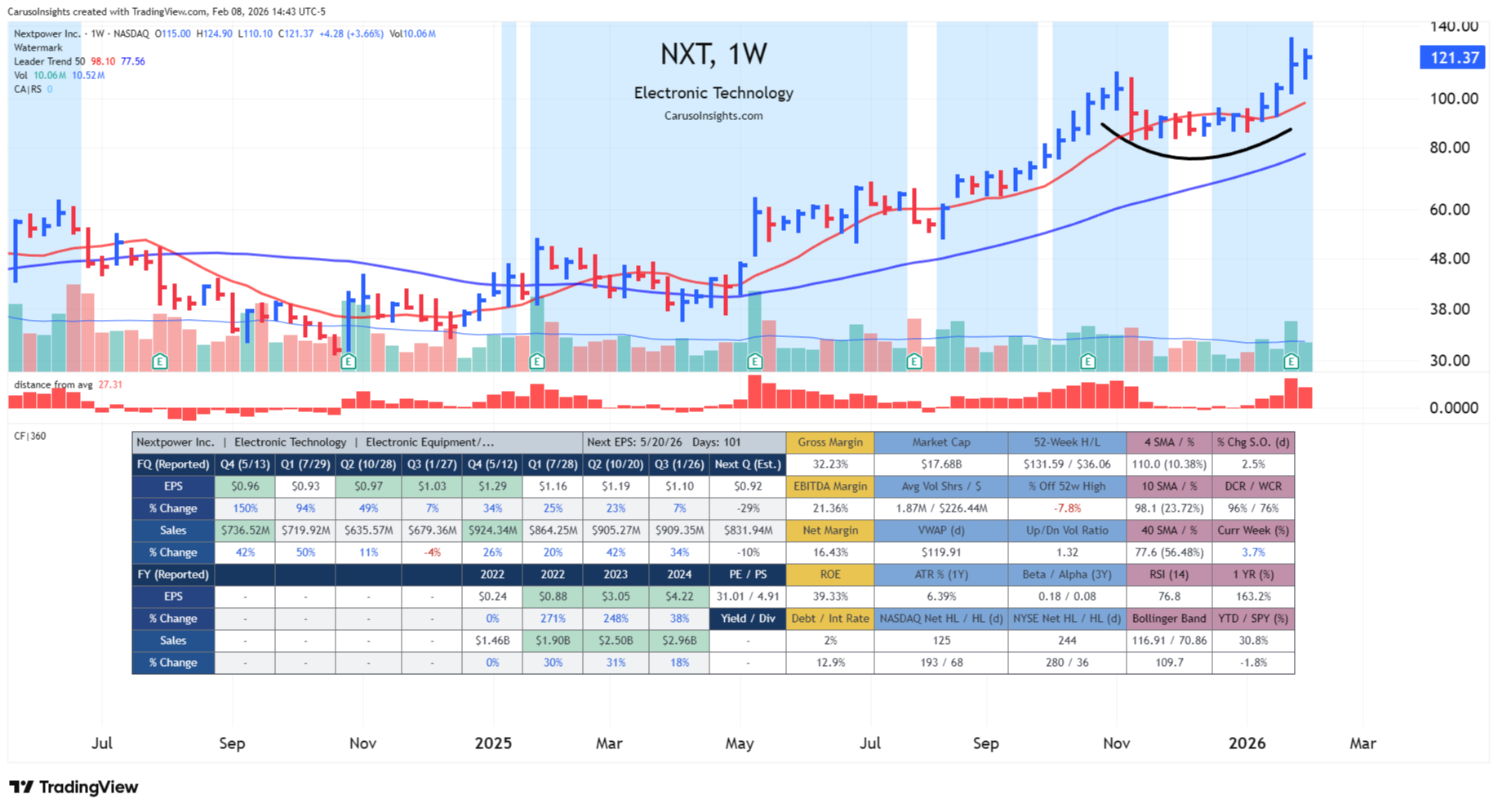
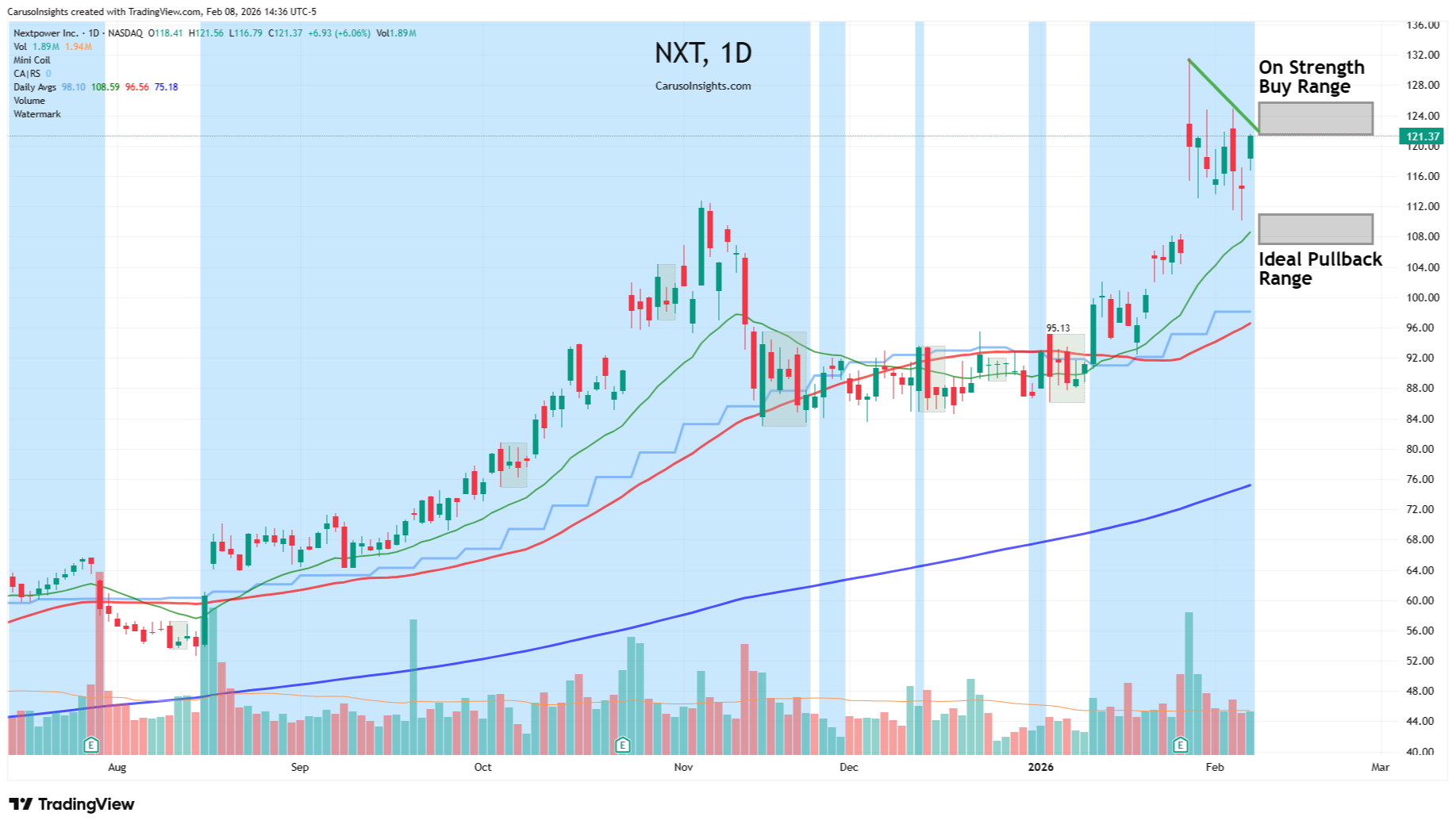
NXT has shown persistent RS since the start of the year and is a key leader within its group, closing at new all-time highs on Friday. Should market momentum continue, NXT offers an attractive entry through its downslopping trendline. Should it consolidate, a high probability buy area emerges at the 21em as a failed breakout pullback entry.
XAR
Theme: Defense Modernization, Aerospace Systems, Advanced Manufacturing
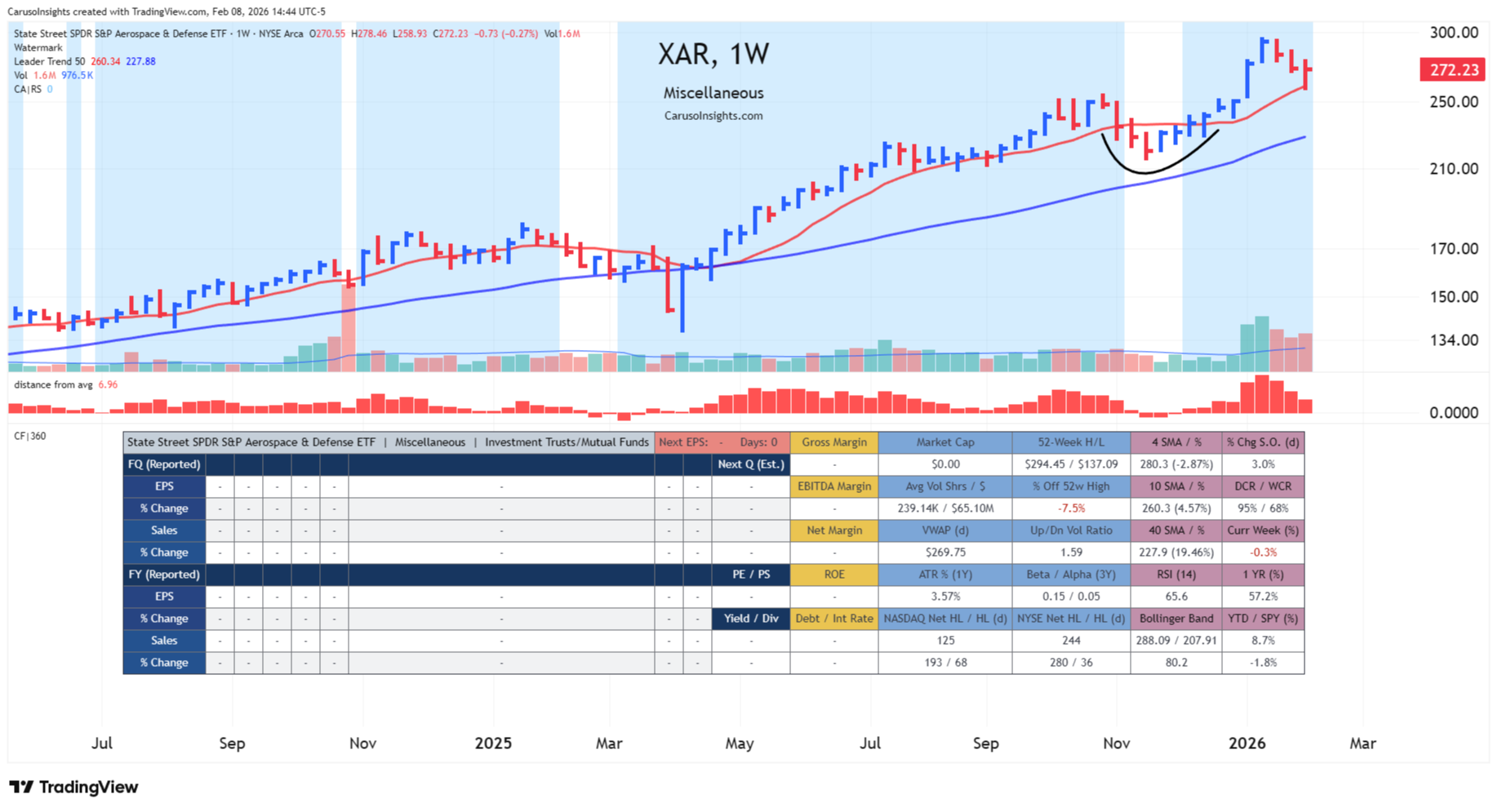
The SPDR S&P Aerospace & Defense ETF provides diversified exposure to the modernization of U.S. and allied defense systems. Rising global instability and sustained defense budgets are driving long-cycle investment in aircraft, missiles, space, and advanced manufacturing. Increasingly, these systems incorporate AI, autonomy, and high-reliability electronics rather than pure legacy hardware.
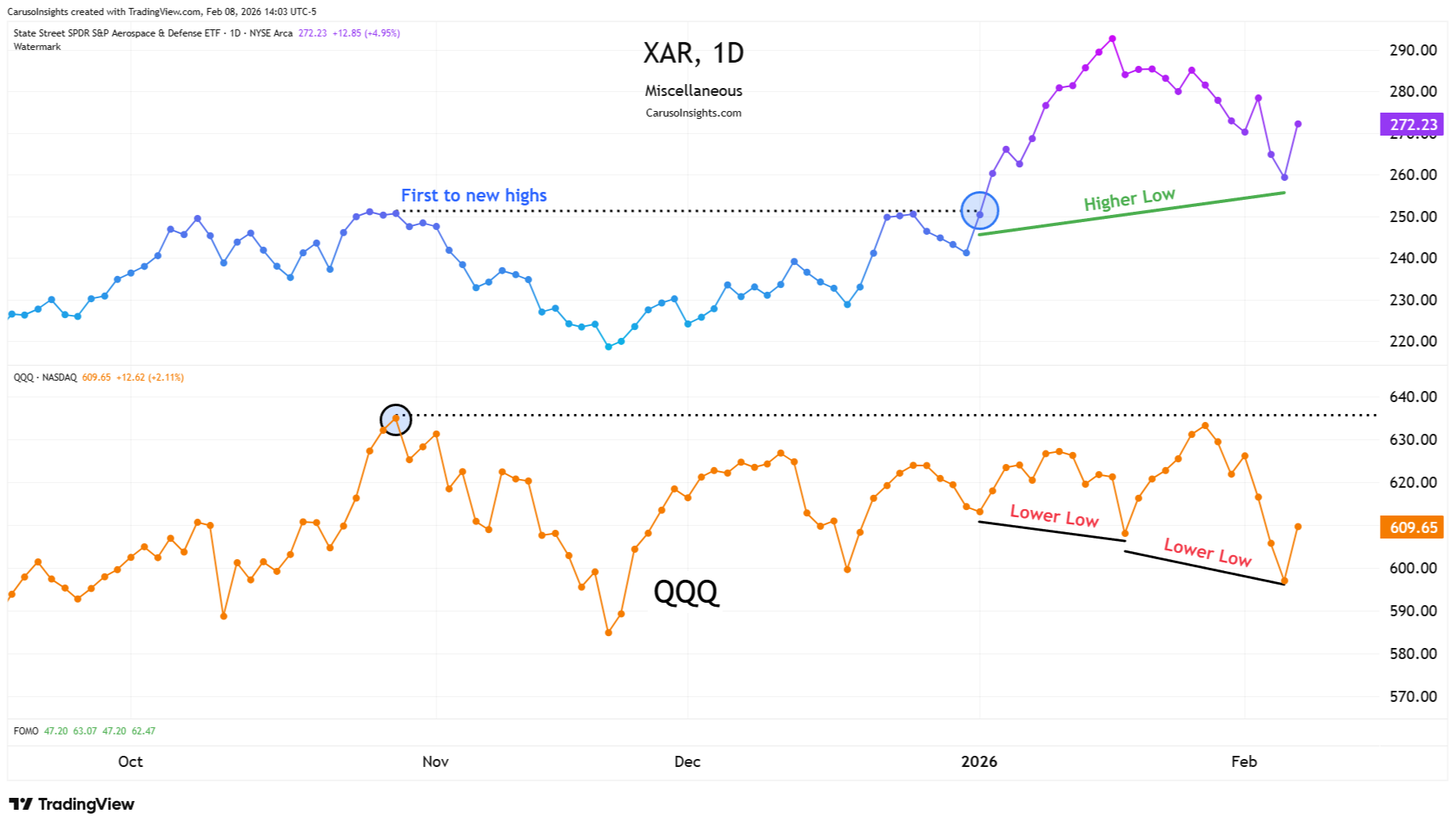
XAR’s equal-weight structure emphasizes operational leverage and mid-cap leaders rather than just the largest primes, often allowing it to outperform during early and mid-cycle defense expansions. Strength in XAR signals institutional rotation toward “real-world” technology—where AI, automation, and manufacturing meet national security priorities.
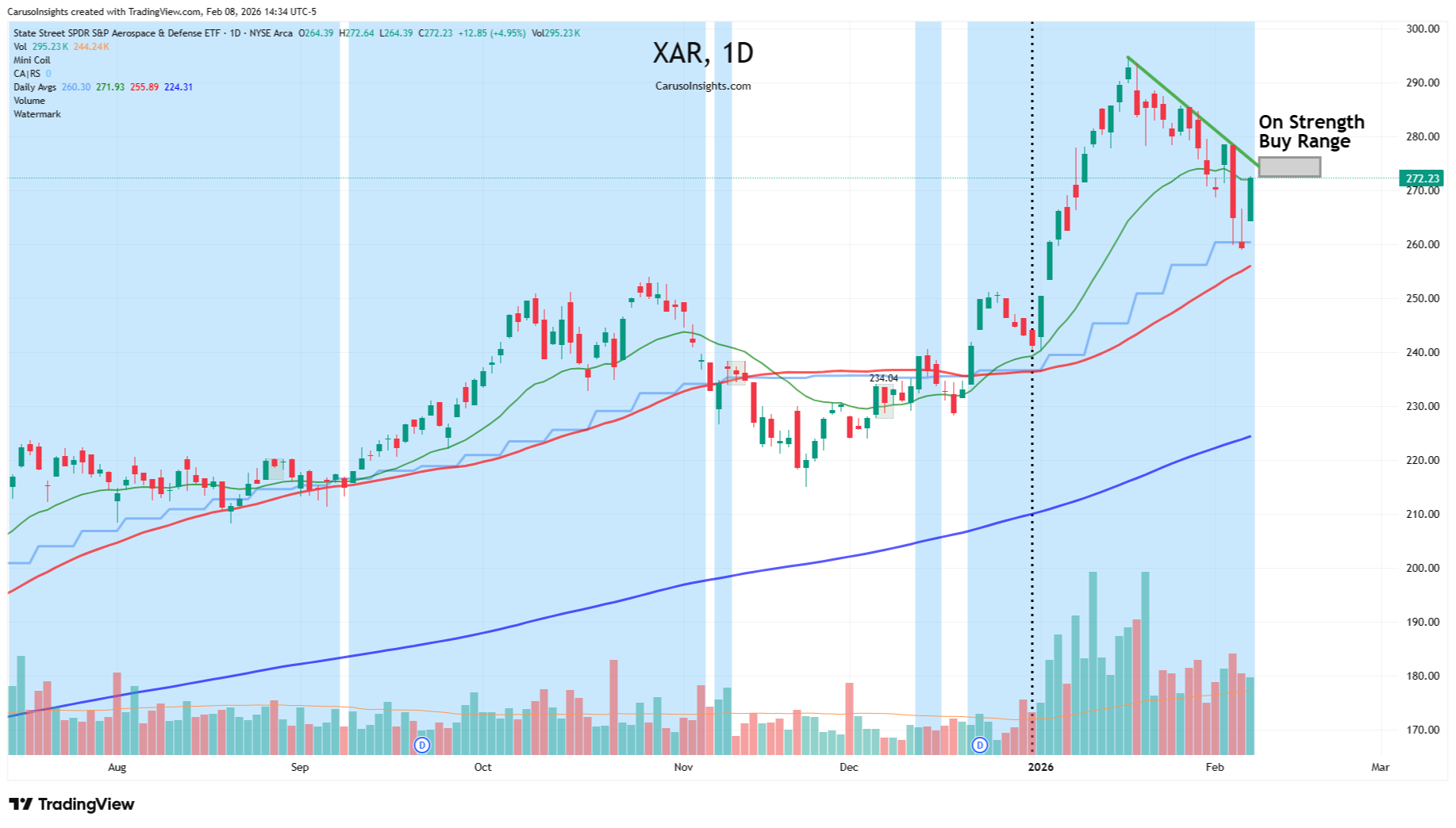
Having broken out of a classic cup with handle formation at the start of the year, XAR retraced to its 10 week average on Thursday and will indicate renewed upside momentum should it climb past its downsloping trend line.
STLD
Theme: Onshoring, Industrial Build-Out, AI & Infrastructure Demand
Steel Dynamics is a direct beneficiary of U.S. onshoring and large-scale industrial investment. As AI data centers, energy infrastructure, manufacturing plants, and defense projects expand, demand shifts toward domestically produced steel with reliable supply chains—where STLD is a low-cost, high-efficiency leader.
Unlike traditional cyclical steel plays, STLD benefits from structurally higher baseline demand tied to infrastructure, reshoring, and electrification. Persistent relative strength often reflects institutional preference for “hard asset” exposure as capital spending moves from digital AI into the physical economy that supports it.
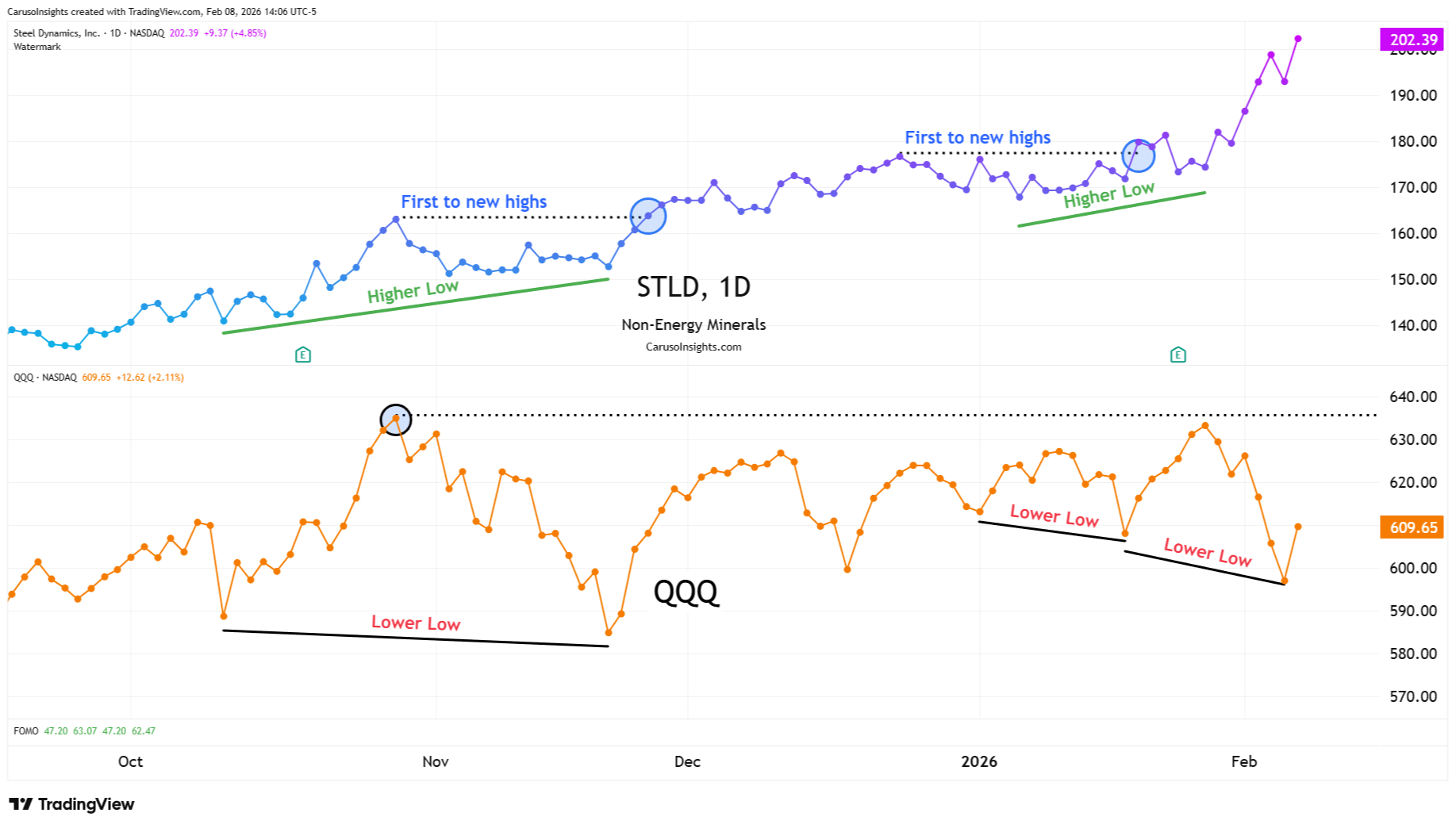
STLD is demonstrating leadership vs. all major indexes as well as fellow commodity leaders. With a swift multi day rally, the stock is extended, but a pullback to its 21ema would offer a high probability entry near the highs of its recent consolidation.
VIAV
Theme: AI Optical Infrastructure, Network Testing & Validation, Data Center Connectivity
Viavi Solutions is leveraged to the plumbing layer of AI and cloud infrastructure. As hyperscale data centers scale out AI workloads, the complexity of optical networks explodes—higher speeds, denser interconnects, tighter tolerances. VIAV provides the test, measurement, and validation tools required to ensure these high-speed optical and network systems actually function at scale.
As AI traffic shifts from compute to data movement, spending increasingly moves toward network assurance rather than just raw hardware. VIAV’s improving RS often reflects early institutional positioning for the next phase of AI capex—where reliability, uptime, and performance validation matter more than incremental bandwidth. With next-gen 800G/1.6T optics and increasingly complex fiber networks, VIAV sits at the center of a durable, multi-year AI infrastructure and connectivity theme.
Having gapped higher on earnings and withstood the worst the market could throw at it last week, VIAV would be considered should momentum continue higher.
TSM
Theme: AI Compute Supply Chain, Advanced Foundry Leadership
TSMC is the core manufacturing hub of the AI ecosystem. Whether GPUs, custom AI chips, or advanced CPUs, leading-edge designs still flow through TSM’s fabs. As AI and HPC complexity rises—especially with chiplets and advanced packaging—TSM acts as the toll booth on global AI compute, offering durable, multi-year exposure with less single-product risk.
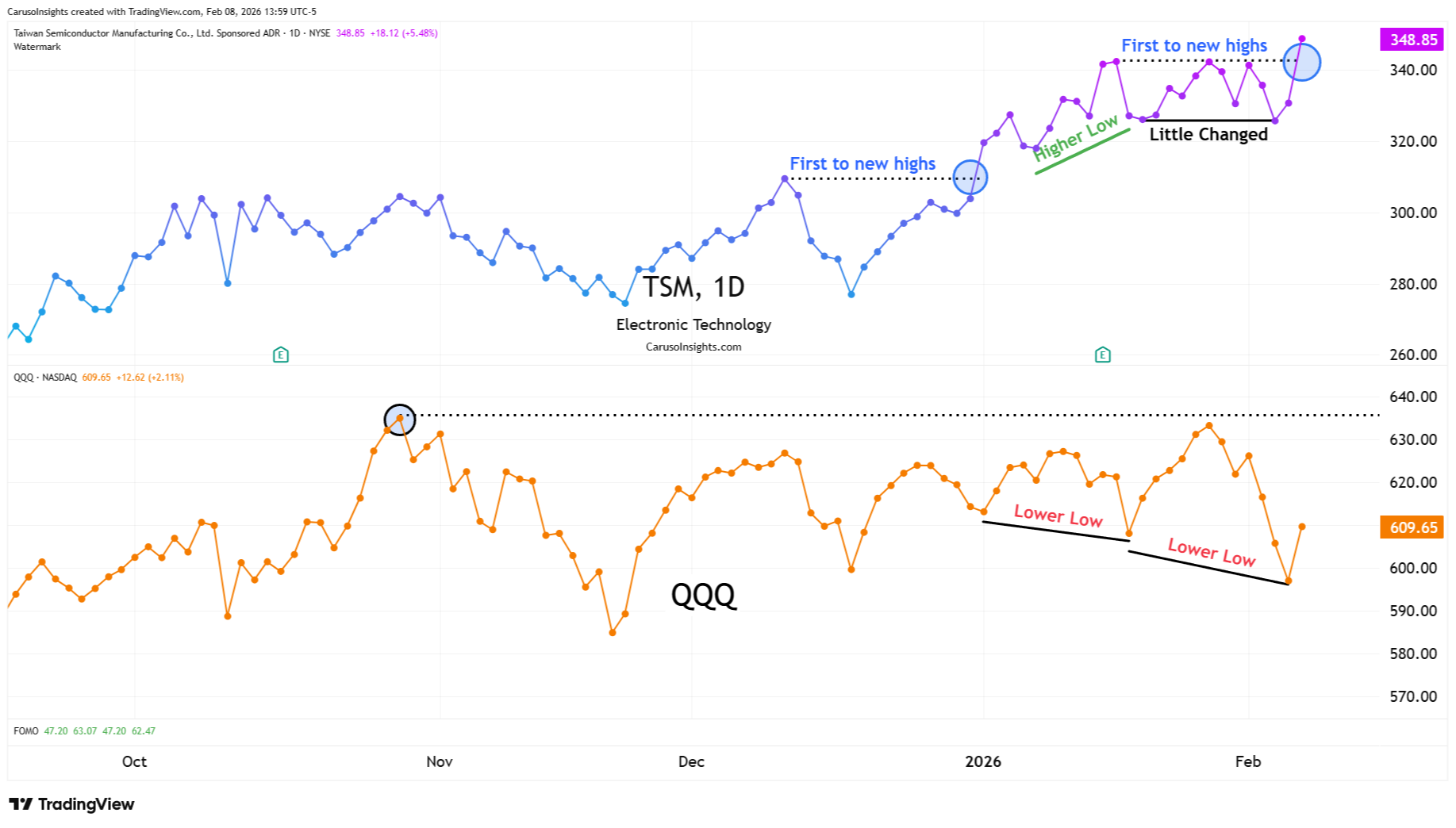
As semiconductor leaders such as NVDA, AVGO, and AMD consolidate, TSM has shown persistent relative strength versus the QQQ, indicating continued institutional accumulation. Although it just rallied 10% in two days, how it behaves near all-time highs will be critical. Buying immediately at the breakout is a low-probability entry, but if the stock consolidates while maintaining strength, it would signal the breakout is real and worth buying in the coming days.